


Why “Switch Dollar” is Gaining Traction in Today’s Interest Rate Environment
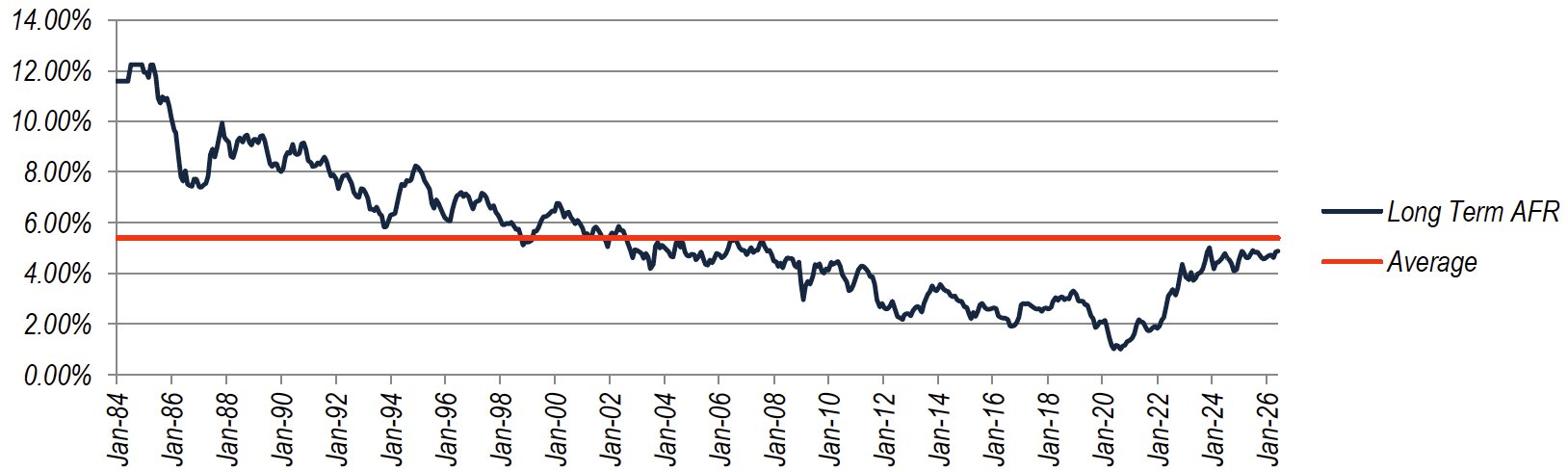
The interest rate landscape has shifted dramatically in the years following the global COVID-19 pandemic. Gone are the days of the 1% long-term applicable federal rate (“AFR”) and sub-3% mortgages. In their place are long-term AFRs approaching 5% and mortgages near 7%. Current interest rates are not necessarily high from a historical perspective (see exhibit 1), but they have certainly led to creative executive benefit plan designs, particularly as it relates to collateral assignment/loan regime split dollar (“split dollar”).
These changing rate conditions are influencing everything from lending strategies to executive benefit plan design.
EXHIBIT 1 (Data Shown from January 1984 through June 2026)
Long-Term Applicable Federal Rate History
For those not familiar with the traditional split dollar construct, it is an executive benefit plan design that has been around since the 1950s. The IRS subsequently came out with final regulations in 2003, which, at the very least, provided guidance for how split dollar plans are taxed. The most common split dollar design in the credit union industry over the past 20 years has been an arrangement whereby a credit union pays the premiums (treated as a loan, and referred to as a “loan” hereafter) on one or more permanent life insurance policies owned by the executive. The policy or policies serve as collateral for the loan. Ultimately, the credit union is repaid the principal amount of the loan plus applicable interest from the policy death proceeds.
Normally, the participating executive is entitled to receive distributions from a policy via income tax-advantaged loans, meaning the executive is permitted to borrow against a policy’s cash surrender value. Split Dollar has become the executive benefit plan of choice for many credit unions nationwide, both because the credit union is made “whole” on the required funding amount (i.e., no long-term expense), favorable accounting and the income tax-advantaged nature of the distributions to the executive.
While split dollar plans come in all shapes and sizes, with underlying whole life, indexed universal life, universal life and variable universal life policies, the primary objective is to ensure that the sponsoring credit union is repaid the principal amount of the loan plus applicable interest. The IRS final regulations dictated that an appropriate amount of interest must be charged on the loan to maintain the tax-advantaged nature of the split dollar construct, as well as the benefits that the participating executive will receive at some point in the future. The “appropriate amount of interest” means there cannot be a below-market loan (i.e., preferential), which is why the AFR mentioned throughout this piece is so vital to ensuring compliance with associated tax laws.
For illustrative purposes, assume a credit union makes a $1,000,000 loan to a 50-year-old executive at a 2% AFR. Interest is going to accrue at a rate of 2% for the life of the loan, and the $1,000,000 loan plus all accrued interest must be repaid to the credit union at the executive’s passing, say age 90. Now, take the same $1,000,000 loan, but apply a 4.5% AFR until age 90. We all understand the power of compounding interest, but it’s still fascinating to actually see the difference (see exhibit 2).
EXHIBIT 2
Effects of Compounding Interest
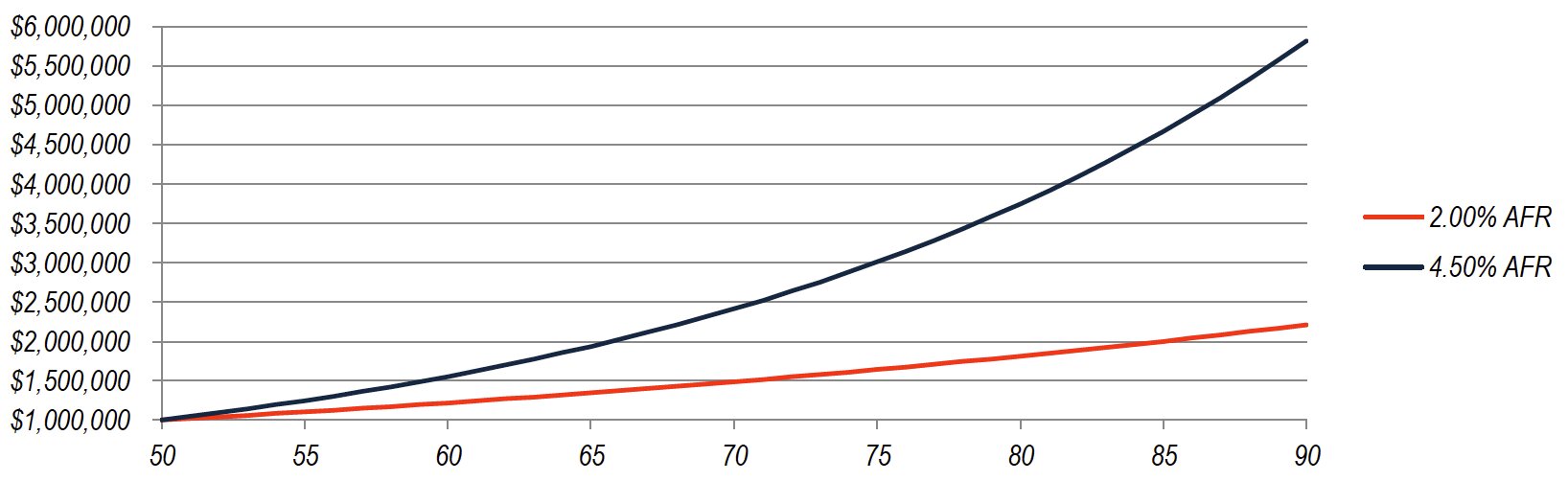
In this example, nearly $3,600,000 in additional interest must be repaid to the credit union from associated policy death proceeds. It stands to reason that this higher repayment to the credit union makes for a more premium-intensive split dollar design. Meaning, at least one of the underlying permanent life insurance policies supporting the split dollar plan is going to require more premium dollars to provide the necessary higher death benefit required to repay the credit union.
One of the ways to mitigate the effects of compounding interest at a higher AFR is to assume a lower AFR at some point in the future. At its core, this is what switch dollar is: an endorsement split dollar arrangement that “switches” to collateral assignment split dollar in the future (e.g., policy year 8) when the AFR hits the target mark. During the pre-switch period, the credit union owns the policies as credit union-owned life insurance, and a portion of the death benefit may be endorsed to the insured executive, creating an annual tax expense based on the share of this death benefit.
What this target mark is will vary by switch dollar design, but it certainly will be at a rate much lower than exists in today’s environment. Not only must the targeted AFR be achieved, but the timing of the assumed rate decrease is equally as important. A switch dollar plan construct may need an AFR of 3.75% in policy year 8 to work as intended and provide the participating executive with the projected distribution amounts (see exhibit 3).
EXHIBIT 3
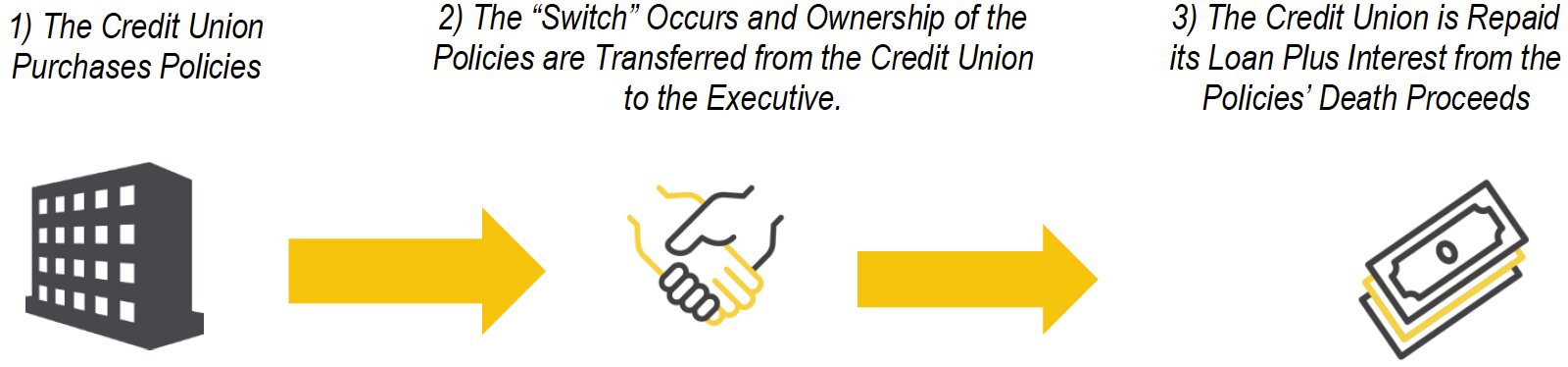
Not only must the AFR hit 3.75% in this hypothetical design, but if the targeted rate is achieved in policy year 3, the policies may not have been designed with enough death benefit to repay this additional five years of interest accrual to the credit union as required. If the targeted rate is not achieved until policy year 12, higher policy cash surrender values will lead to a higher loan amount, again requiring additional repayment to the credit union, which the policies might not be able to support without a reduction in the distribution amounts to the executive.
During the pre-switch period, no vesting in the future projected distributions may be granted to the participating executive since there is no collateral assignment split-dollar plan in place. Ultimately, without the switch occurring, there is no long-term benefit to the executive, no income tax-free dollars as modelled and only a taxable death benefit for as long as the policies are owned by the credit union.
If you are receiving quotes on a switch dollar design, ask your executive benefit firm what interest rate assumption is being used and the basis, including supporting forecasts and calculations for selecting that rate, when the switch to a Collateral Assignment Split Dollar plan is projected to occur, and if the program design still works if interest rates drop sooner or later than anticipated. In our example above, does a switch dollar design that assumes a 3.75% AFR in policy year 8 still accomplish the repayment obligation to the credit union if the AFR suddenly drops to 3.75% in policy year 3? What about policy year 12? Ask your provider to stress-test scenarios to determine the impact on the executive’s benefit and the long-term viability of the switch dollar approach.
Will interest rates drop to a level required for switch dollar programs to work as designed? Only time will tell.
For more information, please get in touch with TriscendNP at 972-318-1110.